
HEALTHCARE SAFETY TRAINING AND CERTIFICATION

Healthcare safety means making sure everyone—patients, doctors, and visitors at hospitals or clinics—is safe and well-protected.

Safety basics in healthcare sector plays an important role in providing a safe and risk-free work environment to one and all.

Let’s have a brief overview of the healthcare Safety Basics online training program.

The module ‘Safety Basics’ healthcare online training program contains brief yet engaging and productive information on safety basics.

$55.37 / BUY NOW GET A QUOTE FOR TEAM
safety-basics-healthcare

OHS – HEALTHCARE SAFETY TRAINING COURSE

The Healthcare Safety course is developed in accordance with Occupational Health and Safety (OHS) standards, ensuring the safety and well-being of all participants.

IN THIS COURSE, YOU WILL LEARN ABOUT

healthcare safety

Occupational Health and Safety (OHS) – Healthcare Safety Basics Online Training Program

The course is both fully narrative and AODA-compliant, and its most convenient feature is the ability to pause at any time. Upon resuming, the course reminder automatically bookmarks your progress and returns you to where you left off.

Lastly, at the end of the module there is a final test that learners’ need to attempt and pass to ensure the successful completion of the safety basics online training program.

$55.37 / BUY NOW

WHO IS ELIGIBLE TO UNDERGO HEALTHCARE SAFETY TRAINING?

Healthcare safety training is typically designed for individuals involved in patient care and related roles, including:

1. Doctors
2. Nurses
3. Paramedics
4. Other personnel involved in patient care

healthcare safety training

WHY IS HEALTHCARE SAFETY TRAINING IMPORTANT?

Healthcare safety training is essential for several reasons. It plays a critical role in ensuring the well-being of both healthcare professionals and patients. Its importance can be outlined as follows:

Enhancing Patient Safety

Emergency Preparedness

Compliance with Regulations

Reducing Medical Errors

Fostering a Culture of Safety

HEALTHCARE SAFETY BASICS TRAINING ONLINE COURSE OUTLINE

The course covers the following topics:

  • 1. Obligations under the Law

    In this chapter, you will learn the following:

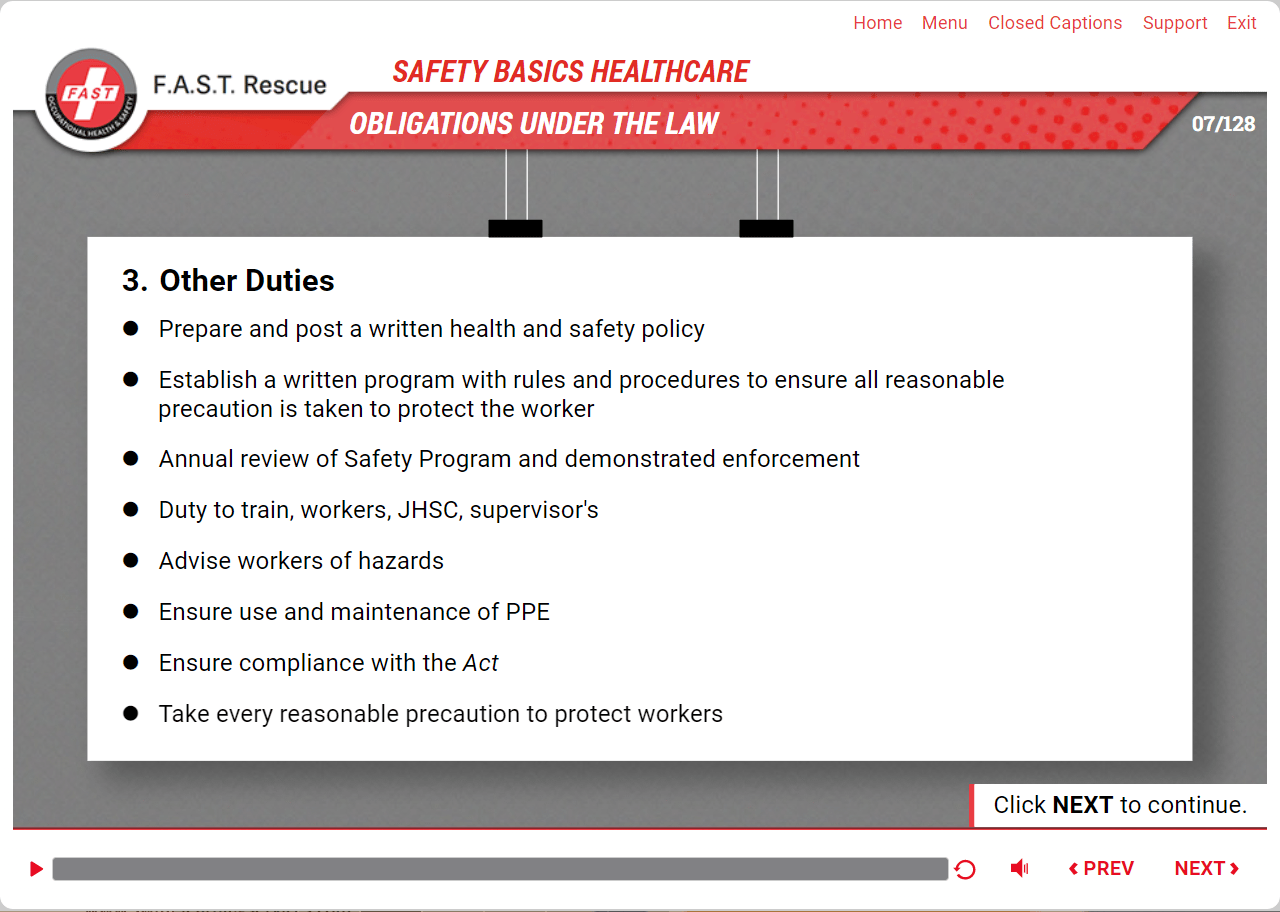
    1. Duty to Provide a Safe Workplace
    2. Appoint Competent Supervisors
    3. Other Duties

  • 2. Workers’ Rights

    Workers’ rights refer to the fundamental entitlements and protections afforded to employees in the workplace. Learn the three rights of the workers’ in the workplace in this chapter. The three rights of workers are:

    1. The Right to Know
    2. The Right to Participate
    3. The Right to Refuse

  • 3. Work Refusal

    Work refusal is when an employee decides not to do a task because they believe it’s unsafe or against workplace rules, prioritizing their safety and well-being. This chapter describes the points on work refusal and reporting of work refusal that have been described in the bulleted points.

  • 4. Worker Responsibilities

    Worker responsibilities refer to the tasks, duties, and obligations that employees are expected to fulfill as part of their job roles. Learn about the worker’s responsibilities, such as their responsibility to work safely, their responsibility to report any hazards to supervisors, and so on.

  • 5. No Worker Shall

    No worker shall sets clear rules by indicating actions or behaviors that are strictly forbidden in the workplace. This chapter outlines three prohibitions for workers in the workplace. They include not removing protective devices, not using equipment in a way that endangers oneself or others, and not engaging in pranks or rough conduct. These prohibitions are in place to ensure workplace safety.

  • 6. Supervisor/Manager Responsibilities

    Supervisor/Manager responsibilities involve overseeing team tasks, providing support, and upholding organizational policies to ensure a productive work environment. In this chapter, learn about the supervisor/manager responsibilities in maintaining employees’ and workplace safety.

  • 7. Ministry of Labour, Training and Skills Development (MLTSD)

    The Ministry of Labour, Training and Skills Development (MLTSD) enforces safety laws in the workplace, established in 1919, to prevent workplace injuries. They coordinate strategies and ensure regulations are followed. Complaints against an employer’s action can be filed with the Ontario Labour Relations Board.

  • 8. Ministry of Labour, Training, and Skills Development – Inspector

    This chapter explains that if a workplace is found violating health and safety regulations during an inspection by the Ministry of Labour, Training and Skills Development (MLTSD) inspector, they have the authority to issue a ticket on the spot for the violation.

  • 9. Ministry of Labour, Training and Skills Development – Ticketing

    This chapter highlights that MLTSD inspectors have the power to issue tickets or summonses for minor violations of the Occupational Health and Safety Act (OHSA). They can also initiate prosecutions for certain violations. The maximum fine for a ticket or summons is $1,000, while most violations are subject to a set fine that is usually not more than $650.

  • 10. Health & Safety Partners

    Health & Safety Partners refers to individuals, organizations, or entities that collaborate to promote and ensure the well-being of individuals in various environments. Learn about the health and safety partners that have been mentioned in this chapter in the bullet points.

  • 11. Workplace Safety and Insurance Board (WSIB)

    The chapter explains the workings of the Workplace Safety and Insurance Board (WSIB). For employers, WSIB provides no-fault collective liability insurance and industry-specific health and safety information. For workers, they offer loss of earnings benefits and health care coverage. WSIB also helps and supports both workers and employers when it is time to return to work after an injury.

  • 12. Due Diligence: Meeting the Requirements of the Law

    This chapter explains that workplace parties, such as employers and employees, are required to understand and comply with their duties and responsibilities as stated in the Occupational Health and Safety Legislation and Regulations. This is necessary for maintaining a safe and healthy work environment.

  • 13. Due Diligence

    In this chapter, you will learn about the definition of due diligence.

    The chapter explains that due diligence involves taking every reasonable precaution to ensure a safe and healthy work environment. It is a basic standard that requires documentation of all health and safety activities and is considered the main defense available. Due diligence is also a proactive management tool that can help prevent accidents and injuries in the workplace.

  • 14. Health & Safety Committees & Representatives

    The chapter ‘Health and Safety Committees & Representatives’ explains the requirements for health and safety committees and representatives in the workplace under the Occupational Health and Safety Act (OHSA).

    A workplace with 6-19 workers must have a health and safety representative, while workplaces with 20 or more workers must have a joint health and safety committee (JHSC).

    The size of the committee depends on the number of workers, with a minimum of half the members representing workers. JHSCs play a crucial role in ensuring workplace safety through inspections, proper training, and promoting the use of personal protective equipment (PPE).

  • 15. WHMIS

    WHMIS stands for Workplace Hazardous Materials Information System. It is a comprehensive system designed to provide information about hazardous materials used in workplaces. The chapter ‘WHMIS’ explains the Workplace Hazardous Materials Information System (WHMIS) and the importance of providing employees with information about hazardous materials in the workplace.

    This information is provided through labels on products, safety data sheets (SDS), and training.

    All employees must participate in an annual review of WHMIS and receive department-specific instruction regarding the controlled products they will use. This is important for ensuring that employees are aware of the risks associated with hazardous materials and can take steps to protect themselves and others in the workplace.

  • 16. Employers/Supervisors

    Employers/Supervisors refers to individuals in leadership positions within a workplace. Employers are responsible for the overall management of the organization, including making decisions about policies, budgets, and staffing. It highlights the responsibilities of employers and supervisors in ensuring the safety of workers who may be exposed to hazardous materials in the workplace.

    This includes ensuring that all containers of controlled products or substances have a legible supplier label, obtaining Safety Data Sheets (SDS) from suppliers and making them readily accessible to workers, establishing education and training programs, providing personal protective equipment (PPE), and updating SDS with new or updated information.

    Employers/supervisors must review information and training programs annually to evaluate their effectiveness and ensure that workers are adequately protected.

  • 17. WHMIS Labels – Supplier and Workplace

    WHMIS labels—Supplier and Workplace refer to standardized labels used in the Workplace Hazardous Materials Information System. Learn about the requirements of WHMIS Supplier Labels and WHMIS Workplace Labels in this chapter.

  • 18. WHMIS Hazard Symbols

    WHMIS Hazard Symbols are standardized symbols used in the Workplace Hazardous Materials Information System. Learn the various WHMIS hazard symbols that have been mentioned along with its labels.

  • 19. Safety Data Sheets

    Safety Data Sheets (SDS) are documents that provide essential information about the properties and hazards of chemical products, ensuring safe handling in the workplace. In this chapter, you will learn about the safety Data Sheets (SDS) along with some exemptions defined by the regulation.

  • 20. WHMIS - Laboratories, Consumer Hazardous Products, Training Requirements

    Learn about WHMIS laboratories that are exposed to a wide variety of hazardous materials in providing both clinical and research services to the Healthcare Sector.

    Also, learn briefly about the consumer hazardous products, types of hazards, degrees of risk, and WHMIS training requirements.

  • 21. Who are at High Risk?

    Identifying individuals or groups more susceptible to certain risks, whether related to health, safety, or other specific circumstances. High risk workers include:

    1. First-Aid Providers
    2. Home Healthcare Workers
    3. Food Service Workers
    4. Long-Term Care Staff
    5. Healthcare personnel in Industry
    6. Linen Service Workers
    7. Nursing Home Workers
    8. Housekeepers/Janitors

  • 22. Hepatitis A, B, and C

    Hepatitis A, B, and C” refer to three different types of viral infections affecting the liver. You will learn about:

    1. Hepatitis A (HAV): Typically transmitted through contaminated food or water, this type is preventable through vaccination.
    2. Hepatitis B (HBV): Can be contracted through contact with infected blood or other bodily fluids; vaccination is available for prevention.
    3. HBV Phases: Hepatitis (HBV) Phases refer to the different stages or phases of a Hepatitis infection.
    4. Hepatitis C (HCV): Mainly spread through contact with infected blood; there is no vaccine for Hepatitis C, but antiviral medications can treat the infection.
    5. HCV Symptoms: HCV Symptoms” refer to the signs and indications associated with a Hepatitis C (HCV) infection.

  • 23. Precautions

    Precautions are preventive measures or actions taken in advance to avoid potential risks, dangers, or undesirable outcomes.

    Precaution is better than Cure

    Learn the precaution methods such as the use of gloves, masks, and protective eye wear to minimize the infection risk.

  • 24. Human Immunodeficiency Virus (HIV)

    Human Immunodeficiency Virus (HIV) is a virus that attacks the immune system, weakening the body’s ability to fight off infections and diseases. HIV progressively destroys the body’s ability to fight infections.

    Learn about HIV, HIV Symptoms, Precautions, AIDS, and AIDS Symptoms.

  • 25. Back Safety

    Back safety refers to the practice of adopting measures and techniques to prevent injury and promote the well-being of the back. Learn the lifting techniques here that assist and ensure the safety of a client and reduce the risk of injury to the healthcare worker.

  • 26. RACE

    RACE is an acronym that outlines a set of actions to be taken in the event of a fire emergency in a healthcare setting. In this chapter, you will learn the ways to recognize, access, evaluate, and control the types of hazards.

  • 27. Housekeeping

    HOUSEKEEPING refers to the practices and protocols implemented to maintain a clean, organized, and hazard-free environment within healthcare facilities. Effective housekeeping can eliminate some workplace hazards, while poor housekeeping frequently contributes to accidents.

    Learn detail about the housekeeping in the workplace to maintain cleanliness and safety.

  • 28. Potential Aggression Grid

    Potential Aggression Grid refers to a structured framework or tool used in healthcare settings to assess and manage the risk of potential aggression from patients or individuals receiving care. Learn the potential aggression grid with the situations and the responses described in the chapter.

  • 29. Personal Protective Equipment (PPE)

    Personal Protective Equipment (PPE) refers to specialized gear and clothing worn by healthcare professionals to safeguard themselves and patients from the transmission of infections and exposure to hazardous materials. Learn about the personal protective equipment’s such as mask, gloves, eye protection, etc. to protect against hazards.

  • 30. Disciplinary Policy for H&S Infractions

    Disciplinary Policy for H&S Infractions refers to a set of guidelines and procedures within a healthcare organization that outline the consequences and actions taken in response to violations of health and safety (H&S) protocols. This policy includes various reasons that shall be applied fairly and equally to all employees.

  • 31. Occupational Illness (OI)

    Occupational Illness (OI) refers to health conditions or diseases that result from exposure to workplace hazards in healthcare settings. A condition that results from exposure in a workplace to a physical, chemical or biological agent that the normal physiological mechanisms are affected and the health of the worker is impaired.

  • 32. Early and Safe Return to Work

    Early and Safe Return to Work involves practices and policies aimed at facilitating the timely and secure return of healthcare professionals to their duties after a period of illness or injury. In the event of a workplace injury there are required steps for early and safe return to work. Learn the necessary steps in this chapter.

  • 33. Safety Hints and Tips

    Safety Hints and Tips refer to practical advice and recommendations provided within healthcare settings to promote a secure and hazard-free environment. When we work safely we all win!

    Learn the safety hints and tips to work safely in a risk-free work settings.

WHAT YOU WILL GET

healthcare safety
  • $55.37/person

  • Course Duration 125 minutes approximately

  • You can make as many attempts as you need to pass the exam; there is no limit

  • Your certificate is valid for 3 years from the date of issue

  • Phone, email and chat on weekdays from 8am – 5pm EST

  • SELF-PACED/ELEARNING

  • RECORD OF TRAINING

  • USER MANAGEMENT

  • INSTANT ACCESS

  • MOBILE FRIENDLY

  • CERTIFICATE

CONTACT US

3 + 2 = ?

WHY CHOOSE OUR CUSTOM ELEARNING SERVICES FOR HEALTHCARE SAFETY TRAINING? 

Custom eLearning services are personalized educational eLearning solutions created to meet specific needs, offering tailored online content for a unique learning experience.  

Our custom eLearning services offer personalized and impactful eLearning solutions, carefully designed to meet the specific requirements associated with the organized provision of medical services. 

healthcare safety training

OHS – HEALTHCARE SAFETY TRAINING COURSE CERTIFICATION

After completing the training program, you will receive a certification for OHS – Healthcare Safety under OHS regulations.

Frequently Asked Questions (FAQs)

Healthcare safety refers to the measures and protocols implemented to ensure the well-being and security of patients, healthcare providers, and visitors within medical facilities.

Healthcare professionals should undergo safety training regularly, with initial training upon entering the profession and periodic refresher courses to stay updated on the latest safety protocols.

Yes, Healthcare Safety Training plays a crucial role in preventing workplace injuries by educating healthcare professionals on proper lifting techniques, the use of protective equipment, and other safety measures.

Healthcare safety protocols should be applied consistently, at all times, during every stage of patient care, from admission to discharge.

Healthcare safety training is typically provided by accredited institutions and organizations specializing in healthcare education, such as medical schools, training centers, and professional associations.

Proper training is important for healthcare safety to ensure that healthcare professionals have the necessary knowledge and skills to handle medical situations, use equipment correctly, and adhere to safety protocols.

Yes, we provide eLearning translation services to accommodate your diverse healthcare workforce. Our language customization options ensure that the Healthcare Safety Training program is accessible in multiple languages, catering to the linguistic needs of all staff members.

Ensuring healthcare safety is a collective responsibility shared by healthcare providers, administrators, support staff, and even patients.

$55.37 / BUY NOW GET A QUOTE FOR TEAM