OHS – DUE DILIGENCE LAW ONLINE TRAINING COURSE & CERTIFICATION

Due Diligence Law refers to the process of thoroughly examining and investigating legal aspects and risks associated with a business transaction, investment, or contractual agreement.

The purpose of the course is to highlight some of the key components that are essential for learners to understand in relation to Occupational Health and Safety (OHS) laws.

Note that the course is not intended to provide all aspects of OHS laws with which learners must comply. Instead, it encourages learners to refer to their province’s Occupational Health and Safety Act, Regulations, and Codes, as well as their own company policies, for more information.

Coming Soon

OHS – DUE DILIGENCE LAW TRAINING COURSE

The due diligence law training course is developed in accordance with Occupational Health and Safety (OHS) standards to ensure a safe and healthy work environment.

IN THIS COURSE, YOU WILL LEARN ABOUT

due diligence law training

Occupational Health and Safety (OHS) – Due Diligence Law Online Training Program

The course ‘Due Diligence and the Law’ emphasizes the importance of being aware of OHS laws and regulations to ensure a safe and healthy work environment and prevent accidents or injuries.

The course covers key topics such as Due Diligence, Legislation, Roles and Responsibilities, Worker Rights, Competent Supervisor, Safety Committee, Workplace Inspections, Workplace Violence, Harassment and Bullying, Hazard Recognition, Training, Reporting and Investigations, and Non-Compliance.

WHO NEEDS DUE DILIGENCE LAW TRAINING?

Due Diligence Law Training is essential for a diverse range of professionals who engage in legal analysis, business transactions, and risk management. The primary audience includes:

1. Legal Professionals
2. Business Executives
3. Investors
4. Corporate Analysts
5. Regulatory Compliance Teams

due diligence law training

WHY DUE DILIGENCE LAW TRAINING IS ESSENTIAL FOR PROFESSIONALS?

Due Diligence Law Training is considered essential for professionals due to several compelling reasons:

Risk Mitigation

Ensuring Compliance

Safeguarding Business Interests

DUE DILIGENCE LAW TRAINING ONLINE COURSE OUTLINE

The course covers the following topics:

  • 1. Due Diligence

    1. What is Due Diligence?
    2. Why is Due Diligence Important?
    3. How is Due Diligence Established?


    What is Due Diligence?
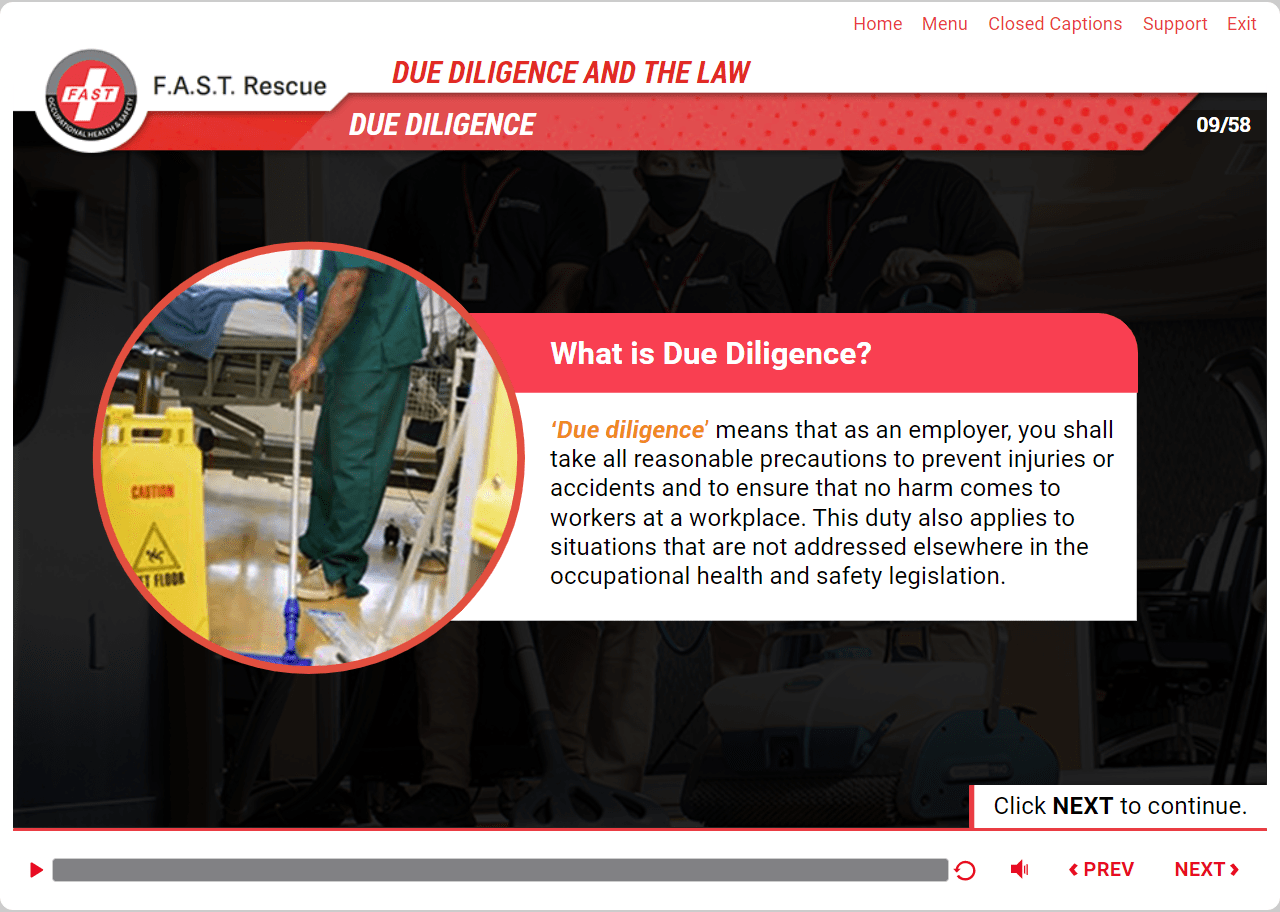
    Due diligence refers to the responsibility of employers to take all reasonable precautions to prevent injuries or accidents and ensure the safety of workers in the workplace.

    The concept of due diligence is essential as it emphasizes the importance of proactive measures to prevent accidents and injuries in the workplace. By taking reasonable precautions, employers can create a safe and healthy work environment, which is beneficial to the workers and the organization as a whole.

    Why is Due Diligence Important?
    The importance of due diligence in the context of occupational health and safety highlights that by being duly diligent, an employer can demonstrate all reasonable precautions that were taken to protect the health and safety of workers.This, in turn, is essential for legal defence in case of any orders, fines, or charges. It also emphasizes that due diligence is demonstrated by the actions taken before an accident or injury occurs, not after.

    Therefore, taking proactive measures to prevent accidents and injuries is crucial to demonstrate due diligence.

    By prioritizing due diligence, employers can not only ensure the safety of their workers but also avoid legal consequences that may arise due to non-compliance with occupational health and safety regulations.

    How is Due Diligence Established?
    Apart from the definition and importance of due diligence, learn how due diligence is established by having a glance at the course. Click here to learn about it.

  • 2. Legislation

    1. Federal Legislation – Bill C45: The Criminal Liability of Organizations
    2. Provincial Legislation
    3. OHS Act and Regulations

  • 3. Due Diligence Law - Roles and Responsibilities

    Roles and Responsibilities refer to the specific duties and functions associated with the legal process of due diligence in business transactions. This chapter explains the Internal Responsibility System (IRS), which refers to the roles and responsibilities of each workplace party, including the employer and workers, to ensure that the workplace is free from hazards and safe.

    The IRS system emphasizes that everyone in the workplace has a responsibility to contribute to a safe and healthy work environment.

    In Ontario, the OHS Act refers to the roles and responsibilities of each party as duties. The content emphasizes that understanding and fulfilling these duties is crucial for ensuring compliance with occupational health and safety regulations and promoting a safe and healthy work environment.

    By prioritizing their roles and responsibilities, each workplace party can contribute to creating a culture of safety in the workplace.

    Roles and Responsibilities includes the following:

    1. Employer’s Duties
    2. Worker’s Duties
    3. Additional Duties

    To learn about each of their duties, check out the ‘Due Diligence and the Law’ course that describes briefly using relevant images to confirm learners’ understanding.

  • 4. Workers’ Rights

    Workers’ rights encompass the fundamental entitlements and protections afforded to individuals employed in the workforce.

    1. The Right to Know
    2. The Right to Participate
    3. The Right to Refuse

    The ‘Due Diligence and the Law’ course provides a detailed look on the three rights of workers that are easy-to-comprehend and retain.

    Click the link below to learn more about it!

  • 5. Competent Supervisors

    Competent supervisors are individuals within an organization who possess the knowledge, skills, and experience necessary to effectively manage and oversee the work of others. The chapter discusses the crucial role of supervisors in the workplace and their responsibility to ensure the health and safety of the workers they oversee.

    It emphasizes that supervisors, like employers, must exercise due diligence in creating a safe working environment.

    Basically, this chapter highlights the importance of competent supervision in ensuring a safe and healthy workplace for employees.

  • 6. Joint Health and Safety Committee (JHSC)

    A Joint Health and Safety Committee (JHSC) is a group within an organization consisting of both employees and management representatives. The chapter is about Joint Health and Safety Committees (JHSC) and their role in identifying and addressing health and safety concerns in the workplace.

    Here, learn about the following:

    1. If your workplace does establish a JHSC, learn a few important points mentioned in the course.
    2. Functions of the JHSC

  • 7. Workplace Inspections

    Workplace inspections involve systematic assessments and examinations of a physical work environment to ensure compliance with safety regulations, identify potential hazards, and maintain a secure and healthy workplace. The course will help you learn about the following in detail:

    1. Why do we do Inspections?
    2. When do we do Inspections?

  • 8. Other Topics

    Apart from the above mentioned chapters, the ‘Due Diligence and the Law’ course also highlights the following:

    1. Workplace Violence, Harassment, and Bullying
    2. Hazard Recognition and Control (RACE)
    3. Training
    4. Reporting and Investigations
    5. Offences and Penalties

WHAT YOU WILL GET

due diligence law training
  • COMING SOON

  • Course Duration 150 Minutes approximately

  • You can make as many attempts as you need to pass the exam; there is no limit

  • Your certificate is valid for 3 years from the date of issue

  • Phone, email and chat on weekdays from 8am – 5pm EST

  • SELF-PACED/ELEARNING

  • RECORD OF TRAINING

  • USER MANAGEMENT

  • INSTANT ACCESS

  • MOBILE FRIENDLY

  • CERTIFICATE

CONTACT US

5 + 2 = ?

WHY CHOOSE OUR CUSTOM ELEARNING SERVICES FOR DUE DILIGENCE LAW TRAINING? 

Custom eLearning services are personalized and tailored educational solutions provided through electronic platforms. 

Choose our custom eLearning services to elevate training, ensuring a safer, more efficient work environment.

1. Tailored to You: Customized for your workplace needs.

2. Engaging Experience: Interactive, real-life simulations, and multimedia elements.

3. Compliance Assurance: Aligned with OHS standards and regulatory requirements.

4. Flexible Access: 24/7 accessibility for operators’ convenience.

5. Cost-Efficient: Reduces downtime and costs associated with traditional methods.

OHS – DUE DILIGENCE LAW TRAINING COURSE CERTIFICATION

After completing the training program, you will receive a certification for OHS – Due Diligence Law under OHS regulations.

Frequently Asked Questions (FAQs)

Due Diligence Law Training is distinct from general legal education as it specifically focuses on the investigative and analytical skills required for thorough legal scrutiny in business transactions.

Due Diligence Law refers to the process of thoroughly investigating and assessing a business or legal matter before making decisions, typically involving mergers, acquisitions, or legal transactions.

Businesses should prioritize Due Diligence Law Training for their teams to mitigate legal risks, enhance decision-making processes, and foster a culture of compliance.

Yes, participants who successfully complete Due Diligence Law Training will receive a certification acknowledging their achievement.

Yes, Due Diligence Law Training can indeed be customized to meet specific industry requirements through our custom eLearning solutions. Our tailored programs ensure that the content is aligned with the unique legal aspects and challenges of different industries.

Due Diligence is commonly applied in various business contexts, including mergers and acquisitions, investment transactions, partnerships, and any situation where a comprehensive evaluation of legal and financial aspects is crucial.

Due Diligence Law Training is essential as it equips professionals with the skills to identify and mitigate legal risks, ensuring compliance and safeguarding business interests.

Neglecting due diligence in legal processes can lead to severe consequences, including legal disputes, financial losses, and damage to the reputation of involved parties.

Due Diligence Law Training is crucial for businesses as it equips them with the knowledge and skills needed to navigate legal complexities, mitigate risks, and ensure compliance.