
Asbestos Controls Training Online Course & Certification

Asbestos is a naturally occurring mineral fiber that has been widely used in construction for its heat-resistant properties. Asbestos Controls Training Online Part 2 Asbestos Controls for Safety Committee Members and Management

The asbestos control online training program provides learners with brief yet productive information on various types of asbestos control, safety practices, etc. to avoid any damage to an organization.

$55.37 / BUY NOW GET A QUOTE FOR TEAM
asbestos awareness training

WHY IS ASBESTOS CONTROLS TRAINING IMPORTANT?

Asbestos controls training is vital to educate individuals on the dangers and precautions associated with asbestos exposure, which poses serious health risks. 

This training equips people with the knowledge to identify and respond responsibly to asbestos-related situations, promoting a culture of safety.

WHO NEEDS TO TAKE ASBESTOS CONTROLS TRAINING?

Asbestos controls training is relevant for individuals working in industries where they may encounter asbestos-containing materials. This includes

Construction workers

Maintenance personnel

Individuals involved in building or facility management

IN THIS COURSE, YOU WILL LEARN ABOUT

Occupational Health and Safety (OHS) – Asbestos Controls Training Online Course

The module adheres to AODA compliance and presents its content through a narrative format, supplemented by relevant images. Each chapter provides an overview of the asbestos controls training program.

A key advantage of this module is its flexibility, allowing learners to pause the course at any time. The system automatically bookmarks the progress, enabling the learners to resume from where they left off.

Upon completion of the module, a final test in the form of multiple-choice questions or choose the correct answer is administered to assess the learners’ understanding.

$55.37 / BUY NOW

ASBESTOS CONTROLS  TRAINING COURSE OUTLINE

The course covers the following topics:

  • 1. Definitions

    In this chapter, learn the precise definitions of the following:

    1. Asbestos
    2. Friable Asbestos
    3. Dust

  • 2. Types of Controls

    There are 3 main types of controls that are as follows:

    1. Elimination
    2. Encapsulation
    3.
    Negative Air Filtration

  • 3. Elimination

    Elimination refers to educating individuals about methods to reduce or eradicate the presence of asbestos in a given environment. In this chapter, you will learn about elimination, which has been described briefly to provide learners with a quick understanding of the elimination type of workplace control. 

  • 4. Encapsulation

    Encapsulation refers to a technique used in asbestos abatement, involving the application of a protective coating or sealant on asbestos-containing materials. Learn the benefits and drawbacks of the encapsulation that has been mentioned in an easy-to-understand manner.

  • 5. Negative Air Filtration

    Negative air filtration involves creating controlled environments using specialized equipment to prevent the release of asbestos fibers beyond the work area. In this chapter, learn about the negative air filtration that requires one or more exhaust units, a fan and series of filters.

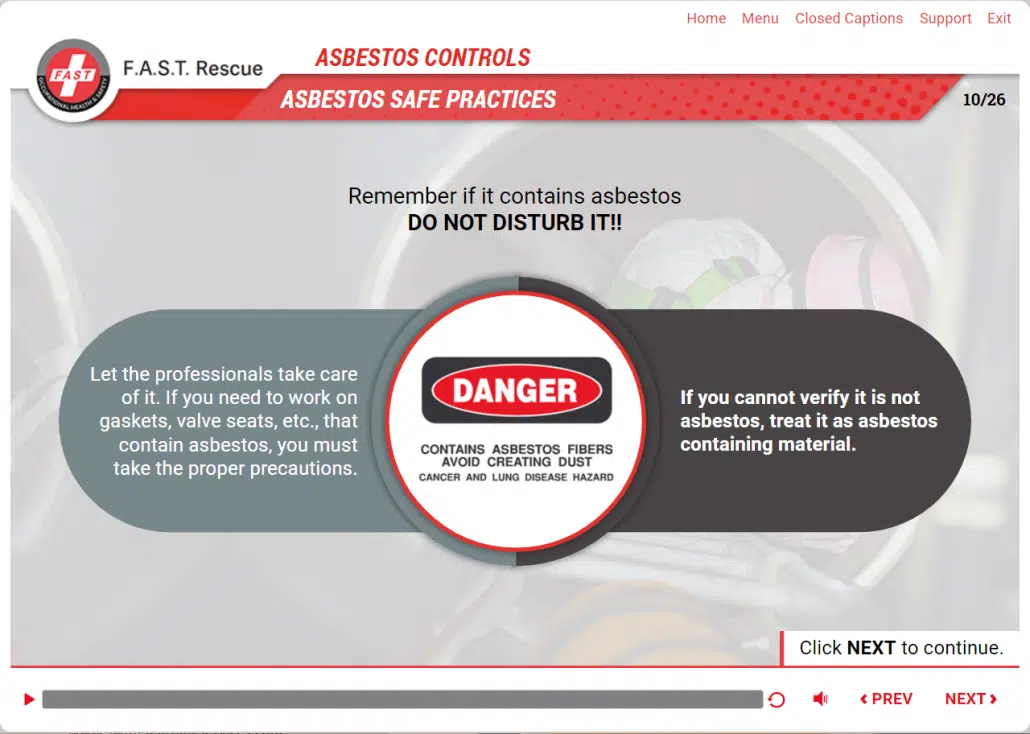
  • 6. Asbestos Safe Practices

    Asbestos safe practices aim to reduce the risk of asbestos exposure when working with materials containing asbestos. In this chapter, you will learn the asbestos safe practices or proper precautions that are necessary to avoid danger in the workplace.

  • 7. Manager Duties

    This chapter describes the manager’s duties, such as training employees, performing an investigation, conducting a workplace inspection, etc., in an easy-to-comprehend manner.

  • 8. Safety Committee’s Duties

    The chapter ensures monthly inspection and include all duties such as reporting accidental damage immediately, danger asbestos, etc.

  • 9. Final Test

    After going through the module, learners have to attempt the final test to ensure successful completion of the training. The final test will be in the form of choosing the correct answer or multiple choice questions (MCQs) to gauge learners’ understanding.

WHAT YOU WILL GET

  • $55.37/person

  • Course Duration 30 minutes approximately

  • You can make as many attempts as you need to pass the exam; there is no limit

  • Your certificate is valid for 3 years from the date of issue

  • Phone, email and chat on weekdays from 8am – 5pm EST

  • SELF-PACED/ELEARNING

  • RECORD OF TRAINING

  • USER MANAGEMENT

  • INSTANT ACCESS

  • MOBILE FRIENDLY

  • CERTIFICATE

CONTACT US

8 + 0 = ?

CERTIFICATION FOR ASBESTOS CONTROLS TRAINING COURSE 

After completing the training program, you will receive a certification for OHS – Asbestos Controls Training.

Frequently Asked Questions (FAQs)

Protecting oneself from asbestos exposure involves awareness, cautious behavior, and, in some cases, professional assistance.

The key precautions and protective measures are:

1. Education and Awareness
2. Personal Protective Equipment (PPE)
3. Professional Consultation

Asbestos is a naturally occurring mineral fiber that has been widely used in construction for its heat-resistant properties.

To protect yourself from asbestos exposure:

1. Identify Asbestos-Containing Materials
2. Use Accredited Professionals
3. Avoid Disturbing Asbestos
4. Follow Safety Guidelines
5. Stay Informed

While personal protective equipment (PPE) is important in reducing the risk of asbestos exposure, it cannot entirely eliminate it.

Asbestos is hazardous because when its fibers are inhaled, they can become lodged in the lungs, leading to serious health issues such as lung cancer, asbestosis, and mesothelioma over time.

Accidental disturbance of asbestos-containing materials can pose immediate risks, requiring prompt action.

The crucial steps to take in such situations are:

1. Evacuation
2. Professional Assistance
3. Medical Evaluation

Yes, our custom e-learning solution allows for the customization of asbestos controls training to meet specific workplace needs and address potential risks.

Discovering asbestos in the workplace requires careful and immediate action to ensure the safety of employees and others who may be exposed.

1. Isolate the Area
2. Notify Authorities
3. Implement Control Measures
4. Educate Employees
5. Engage Professionals

Symptoms of asbestos-related diseases may include shortness of breath, persistent cough, chest pain, and fatigue.

$55.37 / BUY NOW GET A QUOTE FOR TEAM