
Advance Care Planning Training Online Course & Certification

A brief overview of an advance care planning training online program for adults

In this module, we will learn about advance care planning training for adults in order to make their wishes known, regarding their future health and/or personal care.

This advance care planning training online program is a reflective process that considers adults’ wishes regarding their health care.

Coming Soon
advance care planning training

WHAT ARE THE BENEFITS OF ADVANCE CARE PLANNING FOR ADULTS?

Advance care planning (ACP) is an important process that empowers adults to make informed decisions about their health or personal care in the future.

Here are some key benefits associated with creating an advance care plan for adults:

Personal Empowerment

Tailored Medical Care

Minimized Family Conflict

Preservation of Dignity

Enhanced Communication

Preparation for Unexpected Events

WHY IS ADVANCE CARE PLANNING IMPORTANT?

Advance Care Planning is important for adults as it empowers individuals to take control of their healthcare decisions and ensures that their medical treatment aligns with their values and preferences. 

Here’s why it holds significant importance:

1. Autonomy
2. Reduced Family Burden
3. Improved Quality of Care

advance care planning

IN THIS COURSE, YOU WILL LEARN ABOUT

Occupational Health and Safety (OHS) – Advance Care Planning Training Online Course

This module gives you an understanding of advance care planning training and how it impacts your work life, your personal life and possibly even your family and friends.

Advance care planning is a method to let your family and friends know your wishes for your care when you cannot speak for yourself.

The purpose of this advance care planning online training program is to give you the tools to help you guide a client or a client’s family regarding advance care planning.

The module ‘Advance Care Planning’ is fully narrative and AODA Compliant. Each and every chapter of this module is loaded with productive knowledge and training.

ADVANCE CARE PLANNING TRAINING SAFETY TOPICS COURSE OUTLINE

The course covers the following topics:

  • 1. Overview and Purpose:

    This chapter covers the overview and purpose of the course. 

  • 2. Agenda:

    The agenda of this advance care planning training includes the following:

    1. Important Definitions
    2. Speak Up Canada
    3. Five Steps to Advance Care Planning
    4. Provincial or Territory specifics regarding forms, terms, and documents that are legally accepted.
    5. The difference between Advance Care Planning and Power of Attorney

  • 3. Learning Objective:

    By the end of this training, you will be able to:

    1. Have an understanding of Advance Care Planning.
    2. Assist others in understanding Advance Care Planning.
    3. Understand the five steps to Advance Care Planning.
    4. Understand the difference between Advance Care Planning and having a personal or health care directive or power of attorney.
    5. Identify how to access your provincial or territory regulations.

  • 4. Key Terms:

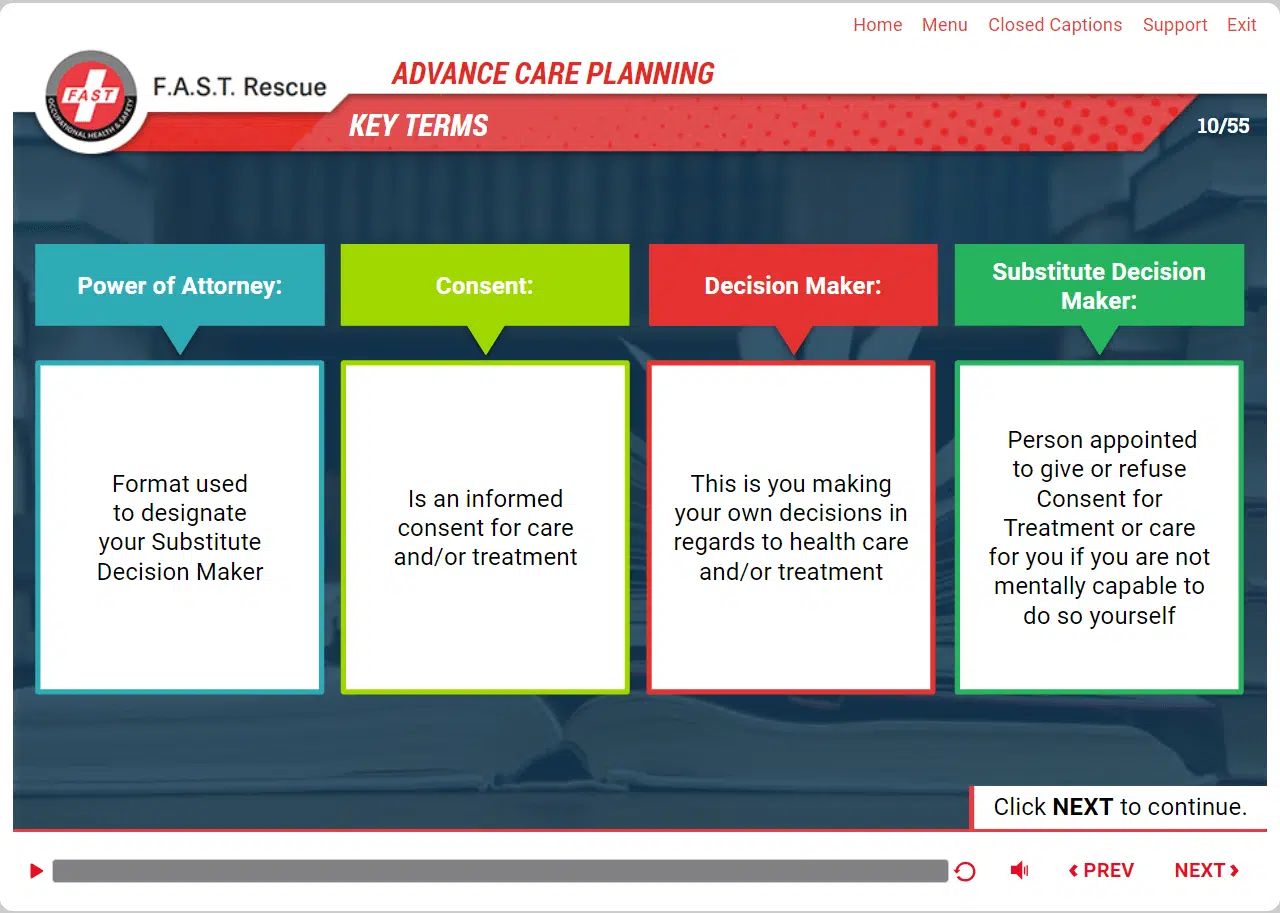
    In this chapter, you will learn the following key terms that will be useful throughout the module:

    1. Advance Care Planning
    2. Personal Directive
    3. Health Care Directive
    4. Power of Attorney
    5. Consent
    6. Decision Maker
    7. Substitute Decision Maker
    8. DNR
    9. CPR

  • 5. Speak Up Canada

    This chapter covers how you should communicate your wishes about your healthcare.

    Speak up Canada is actually an awareness program promoted by federal government for people about ‘Advance Care Planning’.

    It includes the conversation that needs to be about how they want to be treated when healthcare issues arise, as it helps fulfil their wishes.

    There are five steps to Advance Care Planning:

    1. Think
    2. Learn
    3. Decide
    4. Talk
    5. Record

  • 6. Penalties for Late Filing

    Learn about the penalties for late filing Form 7, incomplete form, failure to provide a copy to the worker etc.

  • 7. DNR

    DNR stands for Do Not Resuscitate. This chapter covers whether you want CPR (Cardio Pulmonary Resuscitation) performed on you or not. If you do not want to, then you have to discuss it with your family and doctor, followed by signing a legal form.

  • 8. Advance Care Plan

    This chapter covers why you or your close family member, friend, or doctor should have signed copies, when you are travelling.

  • 9. Accessing Information from where you live

    This chapter describes the easiest way to access the information. It includes the five steps to advance care planning that are universal across Canada.

    You can access the following information using the link provided in this chapter:

    1. Alberta
    2. British Columbia
    3. Manitoba
    4. New Brunswick
    5. Newfoundland and Labrador
    6. Northwest Territories
    7. Nova Scotia
    8. Nunavut
    9. Ontario
    10. Prince Edward Island
    11. Quebec
    12. Saskatchewan
    13. Yukon

  • 10. Summation

    The summation describes that the five steps to advance care planning are the same for all provinces and territories.

  • 11. Conclusion

    It describes what you have learned so far in this module, such as:

    1. What is Advance Care Planning?
    2. How to assist others in Advance Care Planning?
    3. The five steps to Advance Care Planning.
    4. The difference between Advance Care Planning and having a personal/health care directive, or power of attorney.
    5. How to access your province or territory, regulations.

  • 12. Final Test

    Lastly, a final test is given where questions are in the form of MCQs (Multiple choice questions) or choose the correct answer, where learners have to choose one option from the given options.

    The final test gives a clear understanding on whether learners have successfully complete and retain the ‘Advance Care Planning’ module or not.

    Also, learners’ should achieve a 100% passing grade to pass this module.

  • 13. Pre-Injury Phase

    Learn about the pre-injury phase and the need to ensure if they are physically fit to perform the tasks required.

  • 14. Communication Prior to Injury

    In this chapter, learn how to communicate annually based on the questions provided.

  • 15. Pre-Injury Training

    Learn about the pre-injury training needed for the health and safety of the supervisors and managers.

  • 16. Day of Injury

    Learn about all the instructions that you need to take in case of an injury.

  • 17. During Recovery

    In this chapter, you will learn the importance of communicating with the injured workers during recovery and what duties need to be managed while the injured person is at home.

  • 18. Communication

    Learn with whom you need to communicate in case of injury and recovery.

  • 19. Union Responsibilities in ESRTW

    Unions also have responsibilities in ESRTW. They are not to hinder the process of ESRTW between management and the worker.

    In this chapter, you will learn about the union responsibilities in ESRTW and their role in identifying suitable candidates for their job tasks.

  • 20. Red Flags

    In this chapter, you will learn about the situations when you need to raise a red flag regarding worker’s injury and recovery.

  • 21. Hints and Tips

    Learn various hints and tips that will assist you in performing your job more effectively while handling workers’ injuries.

  • 22. Harassment and Violence

    Learn in this chapter what Ontario Human Rights Code, Bill 168 hold about harassment.

  • 23. Four Types of Harassment and Violence

    This chapter explains four types of harassment and violence: Criminal intent, client, worker-related and personal relationships.

  • 24. Bill 168

    Learn details about Bill 168 – since when it has been effective, the purpose of its origin and the changes it suggested to prevent workplace violence and harassment.

  • 25. Workplace Violence

    In this chapter, know what exactly is workplace violence.

  • 26. Workplace Harassment:

    Be aware of various forms of workplace harassment such as bullying, intimidating or offensive jokes or innuendos, displaying or circulating offensive pictures or material and intimidating phone calls.

  • 27. Union Responsibilities

    Unions also have responsibilities in violence and harassment investigations. They should not try to hinder the process between management and the worker for any reason.

    In this chapter, you will learn about union responsibilities in violence and harassment investigations in addition to other relevant useful information.

  • 28. Violence and Harassment

    In this chapter, you will learn about the sections regarding violence and harassment such as domestic violence:

    1. Section 32.0.4
    2. Duties regarding violence: Section 32.0.5 (1)

    Learn about the duties of an employer as per Section 32.0.1 (1), Section 32.0.1 (2), 32.0.1 (3), Section 32.0.4 and section 32.0.5 (1).

  • 29. Final Test

    At the end of the module, there is a final test in the form of multiple choice questions.

WHAT YOU WILL GET

  • COMING SOON

  • Course Duration 60 minutes approximately

  • You can make as many attempts as you need to pass the exam; there is no limit

  • Your certificate is valid for 3 years from the date of issue

  • Phone, email and chat on weekdays from 8am – 5pm EST

  • SELF-PACED/ELEARNING

  • RECORD OF TRAINING

  • USER MANAGEMENT

  • INSTANT ACCESS

  • MOBILE FRIENDLY

  • CERTIFICATE

CONTACT US

2 + 4 = ?

CERTIFICATION FOR ADVANCE CARE PLANNING TRAINING COURSE 

After completing the training program, you will receive certification for Advance Care Planning under OHS regulations.

Frequently Asked Questions (FAQs)

Advance care planning for adults involves making decisions about future medical treatment preferences, ensuring that their healthcare wishes are known and respected.

Advance Care Planning typically involves several legal documents that serve as a guide for healthcare decisions in the event you cannot communicate your preferences.

Common documents include:

1. Living Will
2. Durable Power of Attorney for Healthcare
3. Do Not Resuscitate (DNR)

Advance care planning can take place in various settings, but it is advisable to have detailed discussions with your healthcare provider, family members, and close friends.

Yes, Advance Care Planning can be tailored to address specific medical conditions and potential scenarios.

The eLearning solution customizes content based on your input, adapting to individual preferences, values, and healthcare choices to offer a personalized and relevant learning experience.

Encourage open conversations about healthcare preferences, provide information on available resources, and offer support in completing advance care planning documents, such as living wills and healthcare proxies.

A Custom eLearning Solution plays a pivotal role in facilitating Advance Care Planning by:

1. Tailored Education: Custom eLearning Solution provides personalized educational content that caters to the unique needs and preferences of individuals
2. Accessible Information: Custom eLearning Solution offers easily accessible information at any time, enabling users to learn about Advance Care Planning (ACP) at their own pace.
3. Interactive Engagement: Custom eLearning Solution incorporates interactive elements such as quizzes and scenarios to enhance user understanding and retention.

Adults should initiate advance care planning as early as possible, ideally when they are in good health, to proactively address potential future medical scenarios.

The advance care planning process involves a collaborative effort with several key individuals.

These includes:

1. Healthcare provider
2. Family members
3. Close friends
4. Legal professional

No, Advance Care Planning is not exclusive to older adults. While it is often associated with aging, it is a process that benefits individuals of all ages.

Advance Care Planning goes beyond physical health considerations and can also support mental health and overall well-being.

Yes, you can and should modify your advance care plan as circumstances and preferences evolve.