
Accident Investigation Training Online Course & Certification

Investigating accidents involves identifying the root causes of incidents, workplace injuries, damage to property, and near misses, with the goal of preventing future occurrences. Accident Investigation Training is an integral part of a successful health and safety program. The investigation of accidents and incidents is a critical component in a hazard identification and control program.

This program is designed to give knowledge and information regarding accident/incident investigations. You will learn who is responsible for the various tasks throughout the process.

$55.37 / BUY NOW GET A QUOTE FOR TEAM
accident investigation training

Please feel free to contact us for group enrollments in our courses, please contact us.

OHS – ACCIDENT INVESTIGATION TRAINING COURSE 

The Accident Investigation Training Course has been designed in accordance with Occupational Health and Safety (OHS) standards. This implies that the course aligns with established guidelines and regulations related to occupational health and safety.

WHY IS ACCIDENT INVESTIGATION TRAINING IMPORTANT?

Accident investigation training is vital for several reasons, primarily focusing on improving safety, preventing future incidents, and maintaining regulatory compliance. 

Here are some key advantages:

1. Enhanced Workplace Safety
2. Improved Organizational Compliance
3.
Effective Risk Mitigation
4.
Empowered Workforce
5.
Increased Employee Morale and Confidence

accident investigation

WHO SHOULD UNDERGO ACCIDENT INVESTIGATION TRAINING?

Accident investigation training is beneficial for a broad spectrum of individuals within an organization, ensuring a comprehensive and coordinated response to incidents.

Safety Personnel

Managers and Supervisors

Frontline Employees

IN THIS COURSE, YOU WILL LEARN ABOUT

Occupational Health and Safety (OHS) – Accident Investigation Training Online Program

Accident investigation training also helps you understand who, what, where, when, why, and how of accidents. This accident investigation training program gives you an understanding on how to investigate accidents.

Our AODA-compliant course is fully narrated and features detailed explanations, relevant visuals, and activities to reinforce learning. You’ll take a final test to assess your understanding. With the option to pause and bookmark your progress, you can learn at your own pace.

$55.37 / BUY NOW

ACCIDENT INVESTIGATION TRAINING ONLINE COURSE OUTLINE

The course covers the following topics:

  • 1. Introduction

    This introductory chapter provides information and training regarding accident investigations. Also, learn about the benefits of accident investigations followed by who is responsible for various tasks throughout the process.

  • 2. Due Diligence

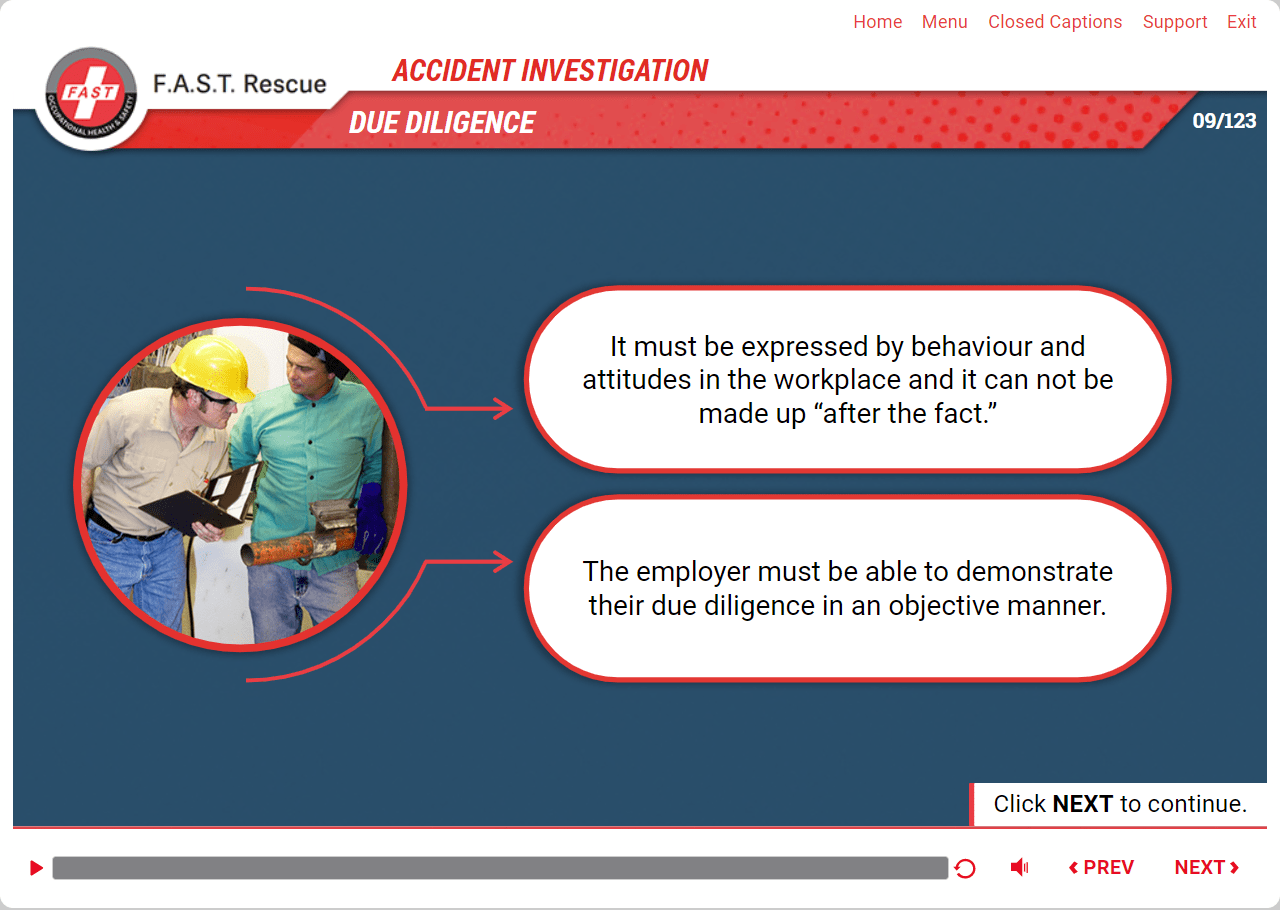
    Learn about all the circumstances in each case to protect the health and safety of all workers in an objective manner.

  • 3. Legislation

    This chapter describes the clear guidelines relating to preservation established by the Occupational Health and Safety Act (OHSA). Also, learn all of the requirements that OHSA requires in a written report.

  • 4. Definitions

    In this chapter, learn about the precise definitions of the following along with the relevant images:

    1. Definition #1 – Accident
    2. Definition #2 – Incident
    3. Definition #3 – Non Critical Injury
    4. Definition #4 – Critical Injury
    5. Definition #5 – Reportable Cases
    6. Definition #6 – Lost Time Injuries
    7. Definition #7 – Modified Duties

    All the definitions are presented in a short yet informative manner to provide learners’ a clear gist of each and every term.

  • 5. Responsibilities

    Learn about the responsibilities of the Joint Health and Safety Committee (JHSC) to investigate accidents. Also, learn about how accident reports are analysed followed by thorough follow-up.

  • 6. Investigation Process

    The investigation process is a systematic and structured series of steps undertaken to uncover facts, analyze information, and derive conclusions related to a specific incident, situation, or concern. In this chapter, learn about the investigation process that is necessary to contribute information about any incident in the workplace. Here, learn the seven steps that are required for effective investigations of accidents/incidents.

  • 7. Take Immediate Action

    Taking immediate action involves promptly and decisively addressing a situation or issue as soon as it arises. This chapter describes various forms of immediate actions followed by important points to remember for an immediate action. Also, learn briefly about the following in this chapter along with relevant images:

    1. Visiting the Scene
    2. Take Control of the Situation
    3. Care for the Injured
    4. Secure the Area
    5. Gather Names and Addresses of Eye Witnesses

  • 8. Gather Evidence

    Gathering evidence is the systematic and intentional process of collecting relevant information, data, or materials to support an investigation or inquiry. In this chapter, learn what things need to be taken into consideration while gathering evidence. Also, learn about the two different methods to gather evidence, along with some useful and important clues.

    This chapter also focuses on the following:

    1. Sketch the scene and take measurements
    2. Sketching tips
    3. Photographs
    4. Photographs taking tips
    5. Worksite inspections
    6. Collecting information
    7. Who to interview?
    8. Categorizing witnesses
    9. When to interview?
    10. Interviewing the witness or victims
    11. How to interview? Tips and Hints

    The information presented in each and every sub-chapter are concise, accurate, and meaningful supported by relevant images.

  • 9. Put the Evidence in Order

    Putting the evidence in order refers to the systematic organization and arrangement of relevant information, facts, and data collected during an investigation. In this chapter, you will learn about how to gather all the facts to put in order to develop a mental picture of what happened. Also, in this chapter, you will learn about the following:

    1. Who was involved?
    2. What were the determining factors?
    3. What procedures were in place at the time?
    4. Where did the accident happen?
    5. Why and How?
    6. Root causes behind the problems

    The information is presented in an easy-to-comprehend manner along with relevant images.

  • 10. Recommendations for Corrective Action

    Recommendations for corrective action are proposed strategies, interventions, or measures suggested following an analysis of an incident or problem. Learn about the recommendations for corrective action listed in this chapter.

  • 11. Follow Up

    In this chapter, learn about the follow up that will help you make recommendations on subsequent incident investigations.

  • 12. Write an Investigative Report

    Investigative report serves as a comprehensive analysis of the incident that occurred on [Date]. Learn how to write an investigative report by taking all the given points into consideration. The points are listed in this chapter.

  • 13. Theories of Accident Causation

    Accident causation theories are frameworks that seek to understand the factors and conditions leading to the occurrence of accidents in various environments. In this chapter, learn about the Heinrich theory and Iceberg theory that are represented using graphical diagrammatic representations followed by brief descriptions.

  • 14. Analysis

    This chapter describes the analysis of an accident that will reveal three causal factors.

  • 15. Causal Factors

    Causal factors refer to the underlying elements and conditions that contribute directly or indirectly to the occurrence of an incident or accident. Learn about the three causal factors i.e. direct causes, indirect causes, and basic causes. Each causal factor is described precisely in a separate chapter along with relevant images.

  • 16. Accident Investigation

    Learn about the preventive measures of an accident presented clearly using flow charts.

  • 17. Determining the Cause

    Determining the cause involves a systematic investigation to identify the fundamental factors and conditions that led to an incident. In this chapter, learn about the 5 factors that can be investigated to find the cause of the accident. The 5 factors for determining the cause include the following:

    1. Material
    2. Environment
    3. Personnel
    4. Management
    5. Task

    Each factor is described separately in different chapters with the support of relevant images.

  • 18. Notification

    In this chapter, all the notifications including notice of death or critical injury, notice of accidents, workplace safety and insurance board are described.

  • 19. Final Thought

    In this chapter, final thought of the module ‘Accident Investigation Training’ is provided as, “A thorough investigation of all accidents and incidents can prevent repeat injuries and possibly fatalities. Always remember it is a fact finding mission, not a place to lay blame.”

  • 20. Final Test

    In the final test provided, questions are in the form of MCQs (Multiple choice questions). Learners have pass the test successfully in three attempts.

WHAT YOU WILL GET

  • $55.37/person

  • Course Duration 2 Hours approximately

  • You can make as many attempts as you need to pass the exam; there is no limit

  • Your certificate is valid for 3 years from the date of issue

  • Phone, email and chat on weekdays from 8am – 5pm EST

  • SELF-PACED/ELEARNING

  • RECORD OF TRAINING

  • USER MANAGEMENT

  • INSTANT ACCESS

  • MOBILE FRIENDLY

  • CERTIFICATE

CONTACT US

0 + 4 = ?

CERTIFICATION FOR ACCIDENT INVESTIGATION TRAINING COURSE 

After completing the training program, you will receive a certification for Accident Investigation under OHS regulations.

$55.37 / BUY NOW

Frequently Asked Questions (FAQs)

The responsibility for conducting accident investigations often falls on a designated team or individual within an organization.

Ensuring the well-being of employees during and after an accident investigation is crucial for maintaining morale, trust, and a positive workplace culture.

Yes, accident investigation training can be effectively conducted online, providing flexibility and accessibility for participants.

Accident investigations typically follow a structured process to ensure a comprehensive analysis.

These steps includes:

1. Immediate Response
2. Gathering Information
3. Root Cause Analysis

Customizing accident investigation through a tailored eLearning solution offers numerous advantages for organizations dedicated to enhancing workplace safety and mitigating risks.

1. Efficient Training: Through the Custom eLearning Solution, employees can access training materials at their own pace, minimizing disruptions to daily operations.
2. Consistent Learning: Utilizing the Custom eLearning Solution ensures that standardized content is delivered, guaranteeing that all team members receive consistent training in accident investigation practices.
3. Cost-Effective: In comparison to traditional training methods, the Custom eLearning Solution reduces costs related to travel, printed materials, and dedicated training facilities.

Accident investigation is a systematic process of examining, analyzing, and determining the root causes and contributing factors of an accident or incident.

Accident investigation training offers individuals numerous professional benefits, contributing to their career development and overall effectiveness in the workplace.

Yes, the accident investigation training is designed to be applicable across diverse industries, ensuring its relevance for various workplace environments.

Accident investigation is a collaborative effort that involves various stakeholders to ensure a comprehensive and accurate analysis of incidents.

1. Management Representatives
2. Internal Team
3. External Consultants

Please feel free to contact us for group enrollments in our courses, please contact us.

$55.37 / BUY NOW GET A QUOTE FOR TEAM