
LADDER SAFETY TRAINING COURSE COVERS STEPSTOOL & STEPLADDER – CERTIFICATION

Ladder Safety Training is a comprehensive program designed to train participants with the knowledge and skills necessary to use ladders safely in various workplace.

Ladder Safety Training Covers Steps Tool and Step Ladder

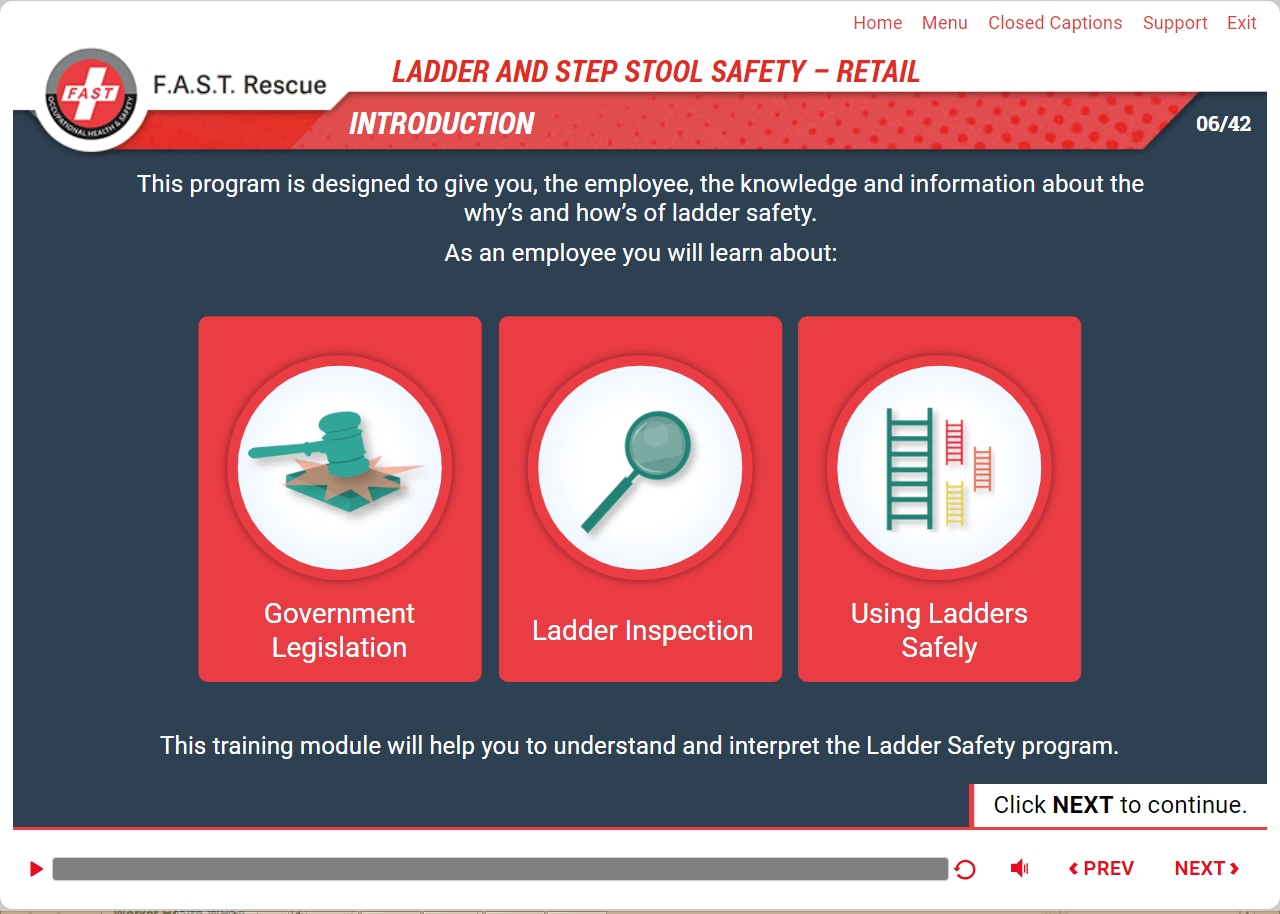
A training program designed to give employees the knowledge and information about the why’s and how’s of ladder safety training.

It is our policy that employees receive training on the proper use of equipment in the workplace. The primary goal of ladder safety is to prevent injuries from improper material handling and slips and falls while using them.

$55.37 / BUY NOW GET A QUOTE FOR TEAM
ladder safety training covers stepstool and stepladder

Please feel free to contact us for group enrollments in our courses! You can email us at [email protected].

OHS – LADDER SAFETY TRAINING COURSE ON STEPS TOOL AND STEP LADDERS 

The ladder safety training course on steps tool and step ladders is developed according to Occupational Health and Safety (OHS) standards to ensure the safe and proper use of ladders in various workplaces.

IN THIS COURSE, YOU WILL LEARN ABOUT

Occupational Health and Safety (OHS) – Online Ladder and step stool safety training program

Ladder and step stool safety training provides employees the guidelines on the proper use of equipment at the workplace.

In this module, each chapter has been explained with the support of relevant images. At the end of the module, there is a final test in the form of multiple-choice questions.

$55.37 / BUY NOW

THE LADDER SAFETY TRAINING COURSE OUTLINE FOR STEPS TOOL AND STEP LADDERS

The course covers the following topics:

  • 1. Introduction

    This introductory chapter describes how ladder and step stool safety training is significant in preventing injuries from improper handling of equipment. Also, this chapter gives a brief introduction on the why’s and how’s of the entire module.

    This chapter includes:

    1. The examination process that must take place prior to the use of the equipment to ensure it is in good working condition.
    2. Damaged or defective equipment must be reported to management immediately.
    3. It is the responsibility of management to follow up and to ensure training is provided and that any damaged equipment is removed from the work environment and repaired promptly.

  • 2. LADDERS - Legislation

    Legislation discovers the regulatory framework and legal requirements governing the proper use of ladders, ensuring compliance with industry standards and promoting a secure work environment. In this chapter, you will learn about the use of ladders taking its measurement, structure, length, and width into consideration. The information is shown with the support of appropriate images. This chapter also provides information about the maximum length of a ladder measured along its side rail.

  • 3. Ladder Inspections

    Ladder inspections involve a systematic examination of ladders to ensure their safety, functionality, and compliance with established standards. Ladders must be inspected for defects before use. When inspecting the ladders, we should look for:

    1. Missing or loose steps or rungs
    2. Damaged or worn non­slip feet
    3. Loose nails
    4. Screws
    5. Bolts or nuts
    6. Loose or faulty spreaders
    7. Locks
    8. Other metal parts in poor condition

    This chapter describes ladder inspections and the things that need to be taken into consideration while inspecting ladders. Damaged ladders should be removed from the work area and tagged for repair or replacement, as soon as possible.

  • 4. Ladder Types

    Ladder Types refers to the diverse classifications and categories of ladders designed to meet specific needs in various settings. There are four main types of ladders that you could have in your business. All types should have non­slip resistant feet and should always be placed on a firm surface.

    This chapter describes the types of ladder using images and the easy-to-comprehend text. Ladder types discussed in this chapter are: portable ladders, step ladders, extension ladders and fixed access ladders.

  • 5. Portable and Extension Ladders

    Portable and extension ladders are versatile tools designed for different purposes. Learn about the portable and extension ladders that are described. They are explained briefly with the support of suitable images.

    Some of the guidelines explained in this chapter include:

    1. Place ladders on a firm level surface and ensure the footing is secure
    2. Do not use ladders near electrical or power lines.
    3. Guard or fence off the area around a ladder erected in an area where persons have access
    4. Secure the ladder firmly at the top to prevent it from slipping sideways or the foot from slipping outwards.
    5. Secure the base of the ladder to prevent accidental movement.
    6. Remember – securing the ladder at the foot doesn’t prevent a side slip

  • 6. Step Ladders

    Step ladders are versatile and practical tools designed to facilitate safe and convenient access to elevated areas. Learn details about the step ladder and the points that need to be taken into consideration while using a step ladder to reach stock. Some of the safety measures regarding step ladders include:

    1. Ladders should be 1 meter (3 feet) shorter than the highest point you have to reach.
    2. Open the stepladder spreaders and shelf fully and lock them in place
    3. Check stability. Ensure the ladder feet are on a firm level and non-slippery surface.
    4. Keep ladders clear from doorways unless they are locked or blocked.

  • 7. Step Stools

    Step stools are compact and versatile tools designed to provide a secure and convenient boost for reaching elevated areas. Learn precisely about the step stools and its use in many work areas that are listed along with images.

    When using a ladder to reach stock:

    1. Make sure ladder is in good condition
    2. Keep ladders clear from doorways unless they are locked or blocked
    3. Whenever possible, place the ladder at a right angle to the work, with either the front or back of the steps facing the work.

  • 8. Rolling Ladders/Stairs

    Rolling ladders, also referred to as rolling stairs, are specialized climbing tools designed for enhanced mobility and convenience. Whenever moving a rolling ladder always make sure the way is clear before you start. Remember, the ladder is much taller than you, so always be sure there is plenty of overhead clearance. Avoid low­hanging light fixtures and other obstructions. Clear any boxes or other items out of the way.

    Rolling ladders have built­in stops and brakes to “lock down” when ready to use. In this chapter, you will learn about rolling ladders/stairs and its use in order to prevent slips and falls.

    Some useful guidelines discussed in the chapter include:

    1. Never have more than one person on the rolling ladder.
    2. Never carry more than you can handle on the rungs of a rolling ladder.
    3. Take time to make two or more trips and carry one item at a time
    4. Don’t go all the way to the top, gather several items, stack them and try to carry them down.
    5. Use a co-worker below and hand down items if possible to avoid carrying them on the steps.
    6. Make sure items can be carried with one hand. The other hand should be free to hold the rail.

  • 9. Fixed Access Ladders

    Fixed access ladders are permanent vertical climbing structures attached to buildings, industrial facilities, or other structures to provide safe and secure access to elevated areas. Maintain three point contact by keeping two hands and one foot, or two feet and one hand on a ladder at all times.

    This chapter covers the fixed access ladders along with the appropriate use of safety devices such as restraint belt, traveling fixture, etc.

  • 10. LADDERS - Safety Tips

    Ladder safety tips encompass a set of guidelines and practices designed to promote secure usage and prevent accidents or injuries. Learn about the safety tips in this chapter. All the safety tips related to footwear, aluminum ladder, applying belt buckle, stretching the ladder at an angle, repositioning the ladder, jumping from the ladder have been discussed in a concise manner along with relevant images.

  • 11. Final Test

    At the end of the module, there is a final test in the form of MCQs (multiple choice questions) or choosing the correct answer.

    After going through the module, learners have to attempt the final test in order to complete the training successfully in three attempts.

WHAT YOU WILL GET

  • $55.37/person

  • Course Duration 40 minutes approximately

  • You can make as many attempts as you need to pass the exam; there is no limit

  • Your certificate is valid for 3 years from the date of issue

  • Phone, email and chat on weekdays from 8am – 5pm EST

  • SELF-PACED/ELEARNING

  • RECORD OF TRAINING

  • USER MANAGEMENT

  • INSTANT ACCESS

  • MOBILE FRIENDLY

  • CERTIFICATE

CONTACT US

6 + 1 = ?

LADDER SAFETY: STEPS TOOL AND STEP LADDER OHS CERTIFICATION FOR WORKPLACE COMPLIANCE

After completing the training program, you will receive a certification for Steps Tool and Step Ladders under OHS Regulations.

$55.37 / BUY NOW

Frequently Asked Questions (FAQs)

A step ladder is a self-supporting and portable ladder designed to provide a stable and secure platform for individuals to reach elevated areas.

Regular inspection of a step ladder is essential to identify any potential safety hazards.

Here’s how to conduct a thorough inspection:

1. Check for Structural Integrity
2. Inspect Hardware and Joints
3. Examine the Steps

No, step ladders are not designed to be used as extension ladders. Attempting to do so can lead to instability and pose a significant safety risk.

Yes, using a step ladder outdoors requires additional considerations to ensure safety.

Here are three important points to keep in mind:

1. Weather Conditions
2. Ground Conditions
3. Secure the Area

Yes, when using steps tools in a professional setting, adherence to guidelines is crucial.

Here are three key considerations:

1. Training and Familiarity
2. Regular Inspections
3. Emergency Preparedness

When working near electricity, additional precautions are necessary.

Here are three crucial guidelines:

1. Non-Conductive Materials
2. Maintain Distance
3. Use Insulated Tools

Yes, step ladders are safe for home use when used correctly. It is crucial to follow proper safety guidelines to prevent accidents.

Proper setup of a step ladder is crucial to ensure stability and prevent accidents.

Follow these steps for a safe setup:

1. Choose a Stable Surface
2. Maintain the Correct Angle
3. Locking Mechanisms

A steps tool, commonly known as a step stool, is a compact and portable device designed to provide a secure and stable platform for individuals to reach elevated areas.

When using a steps tool, safety should be a top priority.

Follow these important measures:

1. Weight Limit Awareness
2. Secure Footing
3. Maintain Balance

No, steps tools are not intended to be a substitute for ladders.

Here’s why:

1. Limited Height Reach
2. Different Design and Purpose
3. Safety Considerations

In a team, coordination and communication are key to ensuring safety.

Follow these precautions:

1. Clear Communication
2. Shared Responsibility
3. Emergency Protocols

Please feel free to contact us for group enrollments in our courses! You can email us at [email protected].

$55.37 / BUY NOW GET A QUOTE FOR TEAM