
OHS – TRANSPORTATION OF DANGEROUS GOODS ONLINE TRAINING COURSE & CERTIFICATION

The Transportation of Dangerous Goods (TDG) Act and Regulations is to promote public safety during the importation of substances and materials that carry risks to human health, safety, and the environment.

A guide to Transportation of Dangerous Goods Training. Each year, more and more workers are handling hazardous materials that are moved across Canada by road, rail, water, and air. Although this is the modern way of shipping manufactured goods, accidents can occur and pose a threat, if not handled properly.

$33.90 / BUY NOW GET A QUOTE FOR TEAM
transportation of dangerous goods training

Please feel free to contact us for group enrollments in our courses! You can email us at [email protected].

OHS – TRANSPORTATION OF DANGEROUS GOODS TRAINING COURSE

The Transportation of Dangerous Goods Training Course is developed according to Occupational Health and Safety (OHS) standards, ensuring regulatory compliance and prioritizing the safety of those involved in the transportation of dangerous goods and materials.

IN THIS COURSE, YOU WILL LEARN ABOUT

Occupational Health and Safety (OHS) – Online TDG – Transportation of Dangerous Goods Training Course

All companies, management, and workers need to be educated about the potential hazards involved when transporting these products. This course provides the required general training guidelines for the purpose.

Upon beginning the course, you have the option to pause it at any time according to your needs. The course will save your progress automatically and allow you to resume from where you left off. It’s worth noting that the course is fully narrated and meets AODA compliance standards.

$33.90 / BUY NOW

WHO IS REQUIRED TRANSPORTATION OF DANGEROUS GOODS TRAINING?

Individuals involved in the transportation, handling, or management of dangerous goods must undergo specialized training to ensure the safe and compliant movement of hazardous materials. This includes:

Drivers

Warehouse Personnel

Documentation and Packaging Staff

WHY IS TRANSPORTATION OF DANGEROUS GOODS TRAINING ESSENTIAL?

Transportation of Dangerous Goods training is essential to ensure the safety of individuals, communities, and the environment. It reduces the risk of accidents, spills, or other incidents during transportation.

TRANSPORTATION OF DANGEROUS GOODS TRAINING COURSE OUTLINE

The course covers the following topics:

  • 1. Introduction

    This introductory chapter explains the potential hazards that are involved in the Transportation of Dangerous Goods and products.

    It talks about the Transportation of Dangerous Goods acts and regulations created in 1992 as the result of a train disaster in Mississauga, Ontario.

  • 2. Why Do We Need Training?

    It is important to realize that at the industry level, if a chemical spill occurs, the workers are always the initial emergency responders rather than the fire department.

    This chapter describes the significance of the ‘Right to Know’ of Transportation of Dangerous Goods (TDG) training to avoid damage or harm to the individuals who are dealing with hazardous substances.

  • 3. Three Training Elements

    In this chapter, you will learn about the 3 training elements that are included in the TDG training, which are as follows:

    1. Identification
    2. Adequate Training
    3. Safety Standards

  • 4. Training Summary

    You will know in this chapter that training is required for everyone involved in the transport of dangerous goods (TDG).

    All the pointers needed for the Transportation of Dangerous Goods (TDG) training are listed in this chapter.

  • 5. Certificate Summary

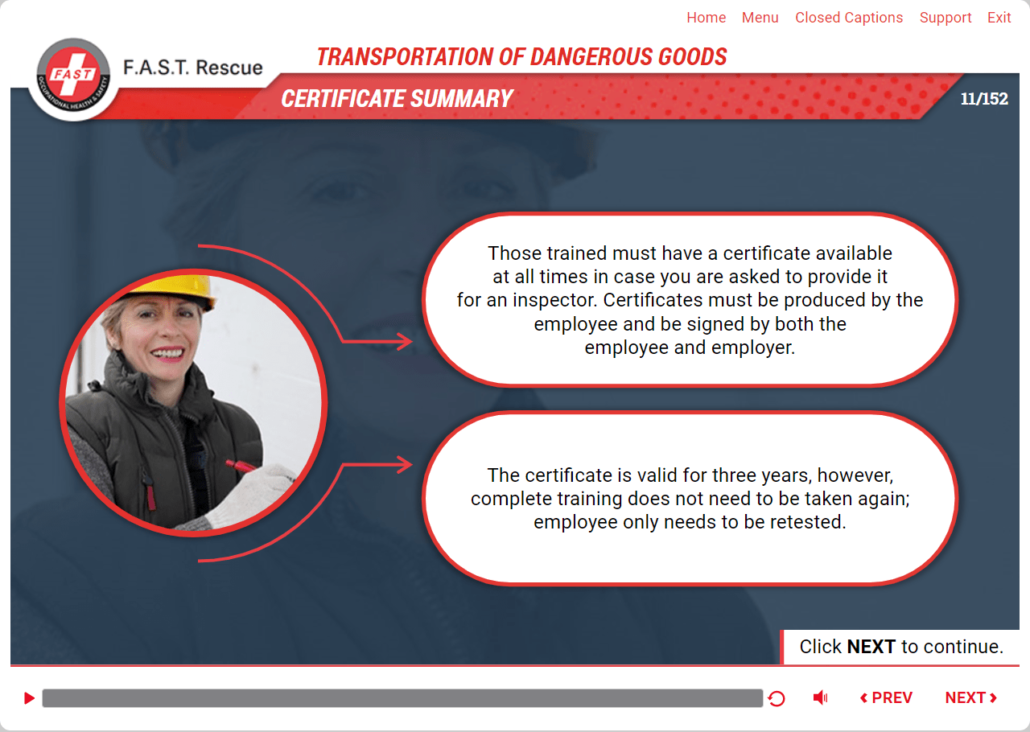
    Certificates must be produced by the employee and be signed by both the employee and employer. In this chapter, you will learn that upon completion of Transportation of Dangerous Goods (TDG) training, the employee will be provided with a certificate, i.e., a certificate of completion, which is valid for three years.

  • 6. Enforcement

    This chapter covers the responsibilities shared between federal and provincial governments along with the job duties of an inspector. Also learn about the details of penalties imposed for the offences.

  • 7. TRANSPORTATION OF DANGEROUS GOODS - RESPONSIBILITIES AND DUTIES

    The transportation of dangerous goods, responsibilities and duties focus on ensuring compliance, prioritizing safety, and implementing measures that contribute to the secure and responsible movement of hazardous materials. In this chapter, you will learn the requirements that are needed for transporting hazardous chemicals.

    Also learn the following three parties who are involved in the handling of hazardous substances for transport.

    1. Shipper
    2. Carrier
    3. Receiver

  • 8. PARTIES INVOLVED IN THE CHAIN OF TRANSPORT - THE SHIPPER

    The shipper refers to the entity or individual responsible for preparing and offering dangerous goods for transportation. You will learn the responsibilities of the shipper in this chapter.

  • 9. PARTIES INVOLVED IN THE CHAIN OF TRANSPORT - THE CARRIER

    The carrier refers to the entity or individual responsible for physically transporting the hazardous materials. Learn the responsibilities of the carrier needed for an effective transportation process.

  • 10. PARTIES INVOLVED IN THE CHAIN OF TRANSPORT - THE RECEIVER

    The receiver refers to the entity or individual who receives and takes possession of the hazardous materials upon delivery. In this chapter, you will learn all the responsibilities the receiver should possess in order to perform their role efficiently.

  • 11. Dangerous Goods Classification

    Dangerous Goods Classification is the systematic categorization of substances and materials based on their inherent characteristics, identifying potential risks they pose during transportation. This chapter deals with the classification of dangerous goods according to the types of hazards. There are 9 classes that fall under the Act and some classes are subdivided to specifically identify the risk.

  • 12. SYMBOLS Classifications

    In this chapter, you will learn the classification symbol in the form of diamond shaped placards that are used to identify dangerous goods. Some classifications do not have classification symbols or division but have packing groups or risk groups.

  • 13. HAZARDOUS MATERIALS - Packing and Risk Groups

    Packing and Risk Groups involve categorizing hazardous materials based on their inherent risks and the packaging requirements associated with them. In this chapter, you will learn the packing groups which are categorized into Great, Medium and Minor based on the inherent danger of the dangerous goods.

    This chapter gives precise definition of risk groups along with additional information that is necessary for classifying infectious substances.

  • 14. DANGEROUS GOODS - Classes

    Classes refer to distinct categories or groups into which items, substances, or materials are organized based on shared characteristics or properties. Know details about class 1 explosives along with chemical reactions and various other components that are related to them.

  • 15. DANGEROUS GOODS - Divisions

    Divisions refer to subcategories or subgroups within hazard classes, particularly in the context of the transportation of dangerous goods. This chapter describes the six divisions of explosives – class 1.1 to class 1.6.

  • 16. DANGEROUS GOODS - Compatibility Groups

    Compatibility Groups refer to specific groupings of dangerous goods based on their compatibility with each other. In this chapter, you will learn about the use of compatibility groups and the number of explosive compatibility groups.

  • 17. Class 1 – Explosives

    Class 1 – Explosives is a hazard class within the classification system for the transportation of dangerous goods. In this chapter, you will learn about class 1 explosives in a well-designed and easy-to-comprehend tabular form where items, descriptions, and compatibility groups are given in three different columns. Brief descriptions for compatibility groups are given.

    Finally, a summary of class 1 explosives is provided that delivers a clear overview of what they should not load or transport different explosives together.

  • 18. Explosive Divisions

    Explosive Divisions categorize explosive materials further within Class 1 of the dangerous goods classification system. This chapter discusses the explosive divisions, from class 1.1 to class 1.5 along with examples.

  • 19. DANGEROUS GOODS - Safety Marks

    Safety marks are visual indicators or symbols used to communicate important information about potential hazards, safety precautions, or regulatory compliance. Learn about the safety marks that are placed on placards and labels 1.1 to 1.6 in this chapter. A brief text about safety marks are provided along with images.

  • 20. Class 2 – Compressed Gas

    Compressed gas is a term used to describe gases that are stored under pressure in containers. In this chapter, you will learn about class 2 compressed gas along with four physical states that are presented.

  • 21. Divisions

    Learn about compressed gas classes 2.1 to 2.3 with examples. Each class has been explained in a comprehensive manner with appropriate examples.

  • 22. Class 2 – Oxidizing gases

    Oxidizing gases are substances that have the ability to promote or sustain combustion in the presence of other materials. In this chapter, you will learn about oxidizing gases and the given labels that should be displayed on dangerous goods.

  • 23. Class 2 – Compressed Gas

    Compressed gas refers to gases that are stored under pressure in containers. This chapter covers the containment exemption from documentation, safety marks, and means of containment of the TDG regulations when being transported by road. Also, this chapter contains the specific requirements for the Transportation of Dangerous Goods.

  • 24. Class 3 – Flammable Liquids

    Flammable liquids are liquids that can easily catch fire and ignite at or below certain temperatures. In this chapter, you will learn about flammable liquids that do not have divisions, but have packing groups.

  • 25. Packing Groups – Flammable LIQUIDS

    This chapter covers packing groups of flammable liquids that have been divided into Group I, Group II, and Group III.

  • 26. Classes and Divisions

    In this chapter, you will learn about class 4 i.e., flammable solids, spontaneous combustibles, and water-reactive substances along with examples and relevant images to provide learners with a clear gist.

  • 27. Divisions

    Learn about class substances, class, water reactive substances, oxidizing substances and organic peroxides, and Toxic or Infectious Substances along with examples.

  • 28. Classes and Divisions

    In this chapter, you will learn about toxic substances and infectious substances.

  • 29. Risk Groups

    This chapter describes the risk group that include micro-organisms. Brief text is provided as explanation along with related image.

    A sample of a virus risk group table is shown where different risk group viruses (Risk Group 4, Risk Group 3, and Risk Group 2) are presented in different columns along with their family, genus, and species.

  • 30. Class 7 – Radioactive Materials

    Radioactive materials are substances that emit radiation due to the presence of unstable atomic nuclei. You will learn about the three categories of radioactive materials that are presented category wise along with images. Also, the colours of each category have been shown above each image.

  • 31. Classes (Class- 8 Corrosives)

    CLASS- 8 Corrosives are substances that have the ability to cause damage to materials, living tissues, or other substances through chemical action. Learn about corrosives, its uses, and examples along with an image.

  • 32. Classes (Class – 9 Miscellaneous)

    This chapter describes a miscellaneous class and all the things that are included in this class.

  • 33. Classes (Danger Placard)

    A Danger Placard is a distinctive and standardized sign or label affixed to a vehicle or freight container to indicate the presence of hazardous materials. In this chapter, you will learn about the danger placard and its use in emergency response assistance along with an image.

  • 34. Exemptions

    Learn about the 150 kg gross mass exemption, dangerous goods safety marks, means of containment, training, etc.

    You will learn about the details of 150 kg gross mass and 500 kg exemptions.

    It has also described the limited quantity of dangerous goods other than explosives in an easy-to-comprehend manner, along with relevant images.

  • 35. Forbidden Dangerous Goods

    Forbidden Dangerous Goods refers to materials or substances that are prohibited from being transported due to their extreme hazards, potential risks, or regulatory restrictions. Learn about the forbidden dangerous goods to understand why it cannot be transported by any means or mode of transportation.

  • 36. Schedules

    Schedules are lists of information that breakdown classifications in a manner of quick reference and easy review. In this chapter, you will learn about the precise meaning of schedules along with its classifications – schedule 1, 2, 3.

  • 37. HAZARDOUS MATERIALS - UN Numbers

    UN Numbers, or United Nations Numbers, are unique identifiers assigned to specific hazardous materials or substances as part of the United Nations’ system for the transportation of dangerous goods. Learn about UN numbers for all dangerous goods along with the samples for better understanding.

  • 38. HAZARDOUS MATERIALS - Shipping Name

    The Shipping Name refers to the designated name assigned to a hazardous material for transportation purposes. In this chapter, you will learn about the names of the dangerous goods that can be given in any means, such as technical names, families of dangerous goods, mixtures of substances etc. Also learn examples of schedule 1 that are presented in the tabular form.

  • 39. Safety Marks

    Safety marks are used to identify the presence of dangerous goods and to make us aware of their classes. This chapter describes the safety marks and its use in the identification of dangerous goods.

  • 40. HAZARDOUS MATERIALS – Labels

    Labels refer to tags or markings affixed to objects, products, or packages to convey information about their contents, usage, or characteristics. Learn about the labels and the use of labels on packages, cylinders and small containers. A brief information along with samples and UN numbers are provided.

  • 41. Placards

    Placards are visual warnings of dangerous goods on large containers or vehicles. This chapter provides brief information on placards, along with sample placards displaying UN numbers.

    The detailed description of placards and UN numbers has been shown in the tabular form that gives complete information on displaying placards using appropriate UN numbers. Learn about the location of placards described in this chapter.

  • 42. Other Safety Marks

    In this chapter, learn about the other safety marks i.e. elevated temperature sign, toxic inhalation, fumigation sign, marine pollutant mark, and certification safety mark along with relevant images.

  • 43. Removal of Safety Marks

    This chapter describes the significance of removal of labels and placards from any means of containment that have been unloaded, unpacked, cleaned or purged.

  • 44. Documentation

    Learn about the shipper’s responsibility to prepare a complete and accurate shipping document. Also, learn about the shipping document information along with requirements and regulations.

    In this chapter, detailed information on documentation is given with support of relevant images.

  • 45. Means of Containment

    Means of Containment refers to the various types of containers, packaging, and containment systems used for transporting dangerous goods or hazardous materials. This chapter describes the means of containment that is required or permitted by the TDG regulations.

  • 46. Loading and Securing

    Loading and Securing refers to the process of placing and fastening cargo, goods, or materials within a transport unit to ensure its safe and stable transportation. Learn about loading and securing of dangerous goods to prevent damage or harm to one selves. An accurate information is given in along with relevant images.

  • 47. Small vs. Large

    Small vs. Large refers to a comparison between objects, entities, or concepts that differ in size or scale. In this chapter, learn about the small means of containment including drums, pails, boxes, crates, and cylinders. It also describes the safety marks and labels that are used for small means of containment.

    Also, learn about the large means of containment i.e. portable tanks, bulk tanks, etc. A detailed information on this type of containment is presented briefly in bullet points.

  • 48. Accidental Release and Duty to Report

    In this chapter, you will learn about the immediate report of the accidental release that an individual who has possession of the dangerous goods should make. Also, learn about the quantity and emission level that are presented in a tabular form.

    A detailed follow-up report and the respective authorities to whom reports should be given, along with the requirements that report should contain, are given in an easy-to-comprehend manner.

  • 49. Emergency Response

    Emergency Response refers to the coordinated actions, procedures, and measures taken to address and manage unforeseen and potentially hazardous situations or incidents. This chapter describes the significance of emergency response and reasonable emergency measures to repair or reduce any danger to life, environment or property. Also learn about the emergency measures provided in this chapter.

  • 50. Consignor Certification and Proof of Classification

    Certification underscores the shipper’s commitment to regulatory compliance and safe transportation practices, while proof of classification substantiates the accurate identification and categorization of hazardous materials. In this chapter, you will learn about the consignor’s responsibility and the validity of proof of classification, i.e., test report, lab report, etc.

    Also, learn about the requirements of documents in order to proceed with proper sampling and accurate analysis.

    In this final chapter, learn about the authorization of certification and the declaration of consignment for the proper and safe Transportation of Dangerous Goods (TDG) according to regulations.

  • 51. Final Test

    At the end of the module, there is a final test with multiple choice questions (MCQs) that learners have to pass successfully in three attempts.

WHAT YOU WILL GET

  • $33.90/person

  • Course Duration 2 hours 20 minutes approximately

  • You can make as many attempts as you need to pass the exam; there is no limit

  • Your certificate is valid for 3 years from the date of issue

  • Phone, email and chat on weekdays from 8am – 5pm EST

  • SELF-PACED/ELEARNING

  • RECORD OF TRAINING

  • USER MANAGEMENT

  • INSTANT ACCESS

  • MOBILE FRIENDLY

  • CERTIFICATE

CONTACT US

5 + 2 = ?

CERTIFICATION FOR TRANSPORTING DANGEROUS GOODS TRAINING COURSE 

After completing the training program, you will receive a certification for transporting dangerous goods under OHS regulations. 

$33.90 / BUY NOW

Frequently Asked Questions (FAQs)

Dangerous goods, also known as hazardous materials, include a wide range of substances that pose potential risks to health, safety, and the environment during transportation. These materials include explosives, flammable liquids, gasses, and toxic substances.

Dangerous Goods are classified based on their inherent characteristics, such as toxicity, flammability, and reactivity. This classification system helps in determining the appropriate safety measures during transportation.

Ensuring the safety of Dangerous Goods during transportation involves a combination of preventive measures, employee training, and emergency response planning.

Air transportation of Dangerous Goods is subject to stringent regulations due to the unique challenges associated with flying. Compliance with these rules is vital for aviation safety.

Transportation of Dangerous Goods training is required due to the nature of their operations. These industries are:

1. Chemical Manufacturing
2. Pharmaceuticals
3. Oil and Gas

Our eLearning solutions accommodate diverse learning styles through their versatile delivery methods and interactive content.

Some of these include:

1. Visual aids
2. Interactive modules
3. Narration and text

The transportation of Dangerous Goods is overseen by various regulatory bodies at the international, national, and regional levels. Different countries may have their own regulatory agencies, and compliance is important to maintaining safety standards.

Proper packaging and labeling are crucial aspects of transporting Dangerous Goods. They ensure that the goods are handled and transported safely, reducing the risk of accidents and damage.

Transporting Dangerous Goods by road demands special precautions to ensure the safety of the carrier, other road users, and the environment.

The transportation of Dangerous Goods is heavily regulated to mitigate the inherent risks associated with their movement. These regulations are in place to safeguard individuals, communities, and the environment.

The key reasons are:

1. Risk Mitigation
2. Environmental Protection
3. Safety Assurance

We can customize the Transportation of Dangerous Goods training course to meet your specific needs and requirements. This allows us to tailor training programs to the unique characteristics of industries, the types of dangerous goods being transported, and the roles of individuals involved in the process.

Please feel free to contact us for group enrollments in our courses! You can email us at [email protected].

$33.90 / BUY NOW GET A QUOTE FOR TEAM